
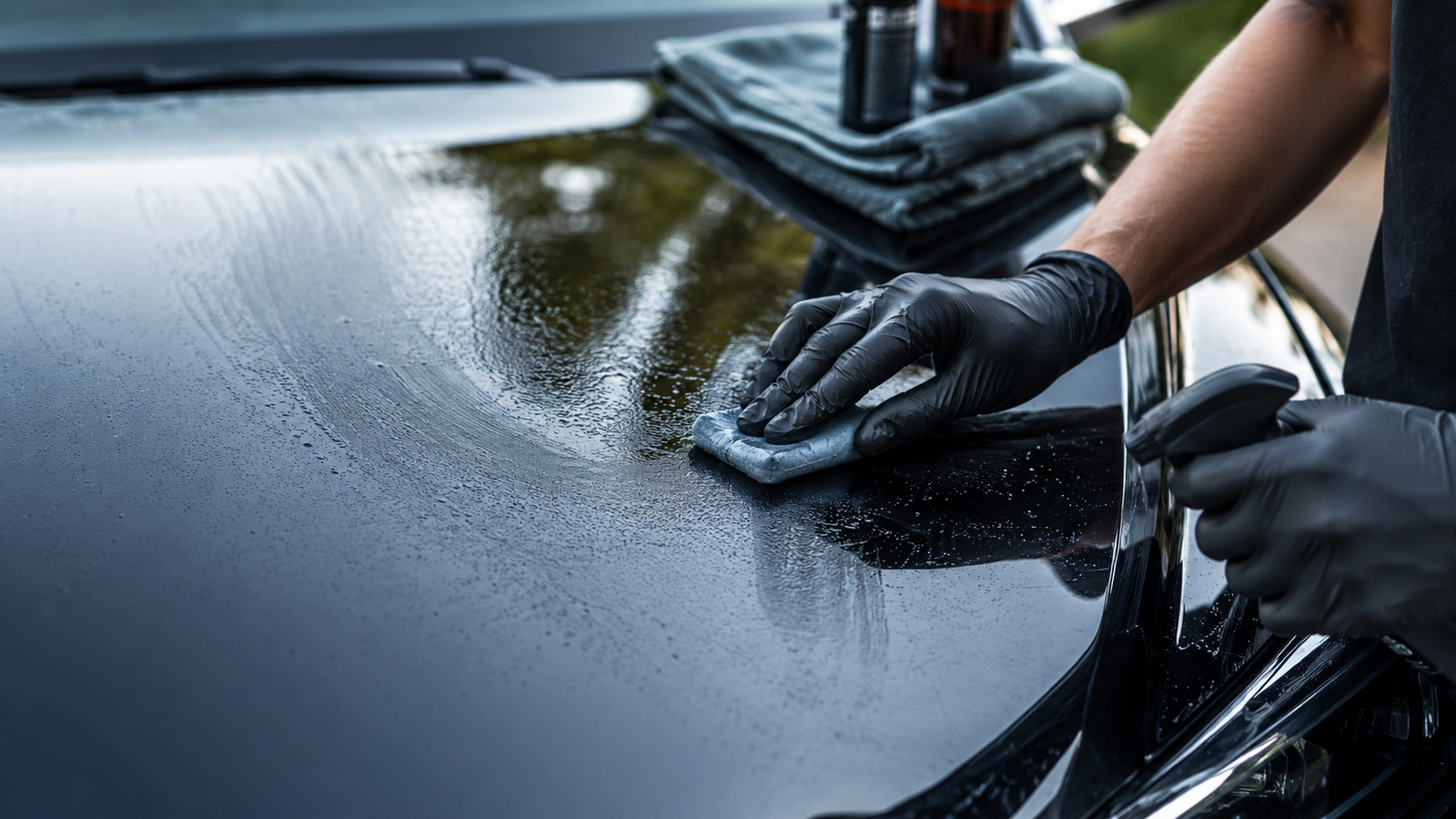
A clay bar treatment is a professional-grade detailing process that removes bonded surface contaminants, like tar, rail dust, tree sap, and industrial fallout, from your vehicle’s paint, glass, and metal surfaces. These embedded particles sit beneath the surface, making them impossible to remove through regular car washing alone.
If your paint feels rough or looks dull even after a thorough wash, clay bar decontamination is the essential next step in any proper paint correction and ceramic coating prep routine.
What Is a Clay Bar and How Does It Work?
A clay bar is a malleable, resin-based compound used in automotive detailing to remove embedded contaminants from painted surfaces. Unlike traditional car washes or foam cannon cleaning, clay bars physically lift and trap particles that have bonded at the molecular level to your vehicle’s clear coat. During the clay bar process, a detailer or DIY enthusiast glides the bar across a lubricated surface in straight, overlapping strokes. The clay absorbs and extracts contaminants such as:
- Industrial fallout and rail dust
- Tree sap and pine resin
- Tar and asphalt residue
- Brake dust particles
- Overspray from paint or adhesives
- Airborne pollution deposits
The result is a surface that passes the “baggie test” , a simple quality check where you place your hand inside a plastic bag and run it over the paint. Smooth paint means clean paint.
Types of Clay Bars: Which One Is Right for Your Vehicle?
Not every clay bar is created equal. Choosing the wrong grade can cause marring or leave swirl marks on your paint. Here is a breakdown of the main types available:
| Clay Bar Grade | Aggressiveness | Best Used For |
| Fine/Mild Clay | Low | Lightly contaminated or newer vehicles |
| Medium Clay | Moderate | Average contamination, annual maintenance |
| Heavy/Aggressive Clay | High | Severely neglected or heavily contaminated paint |
| Synthetic Clay Pad | Variable | Clay mitt or foam pad alternatives, faster coverage |
For most daily drivers and passenger vehicles, a medium-grade bar delivers the best balance between decontamination ability and paint safety. Heavy clay bars should only be used when deep fallout removal is needed, as they carry a higher risk of introducing micro-scratches to the paint film.
Synthetic clay pads and clay mitts have gained significant traction in professional detailing shops as faster alternatives, though traditional bars still offer superior control on intricate body panels and trim areas.
Does Your Car Actually Need a Clay Bar Treatment?
This is a common question among vehicle owners who are new to paint decontamination. The short answer is, if you drive your car outside regularly, yes, it almost certainly does.
Here are the key signs your vehicle needs clay bar decontamination:
- Paint feels rough or gritty after washing
- Visible speckling or brown spots on light-colored paint
- Water does not bead properly after a wash
- You live near industrial zones, railways, or construction sites
- Your vehicle has not been clay barred in over 12 months
- You notice a dull or hazy appearance on the clear coat
According to detailing industry professionals, up to 90% of vehicles on the road have some level of embedded contamination that regular washing cannot remove. This contamination sits within the clear coat layer and, if left untreated, can cause long-term paint oxidation and etching.
Step-by-Step Clay Bar Treatment Process
Understanding the full workflow helps you set realistic expectations, whether you are visiting a professional detail shop or doing it yourself at home.
What you will need:
- Clay bar kit (includes clay and lubricant in most packages)
- Dedicated clay lubricant or quick detailer spray
- Microfiber towels, minimum 380 GSM weight
- A clean, freshly washed vehicle
The decontamination process:
- Wash and dry your vehicle thoroughly first, clay bar should never be used on dirty paint
- Work one panel at a time in a shaded area, direct sunlight dries lubricant too quickly
- Knead the clay bar into a flat disc shape, roughly the size of your palm
- Spray the panel surface with clay lubricant generously
- Glide the clay bar across the surface using light, overlapping passes in a straight-line motion
- Wipe the lubricant residue with a clean microfiber towel
- Fold the clay bar regularly to expose a fresh surface and prevent cross-contamination
- Repeat on all painted panels, glass, and chrome trim
The total time for a full clay bar treatment on a standard sedan is typically 1.5 to 3 hours depending on contamination level and experience.
Clay Bar Treatment Cost : Professional vs DIY
One of the most frequent considerations for car owners is whether to hire a professional detailer or tackle the process at home. Both options are valid depending on your budget, time, and comfort level.
Professional clay bar service pricing:
- Sedan or compact car, $80 to $150
- SUV or truck, $120 to $200
- Luxury or exotic vehicle, $200 and above
DIY clay bar kit pricing:
- Entry-level kit, $15 to $30
- Professional-grade kit, $40 to $80
- Premium synthetic clay alternatives, $25 to $60
The DIY route delivers significant savings over time, but requires proper technique to avoid paint marring. If your vehicle has a soft clear coat, common on European brands like BMW, Mercedes-Benz, and Volkswagen, professional detailing is the safer investment.
What Happens After Clay Bar Treatment?
This is where many vehicle owners miss an important step. Clay bar decontamination strips away not just contaminants but also any existing wax or paint sealant protection. Leaving paint bare after clay treatment accelerates oxidation and UV damage.
After completing the clay bar process, always follow up with at least one of the following:
- Spray wax or liquid carnauba wax: fastest option, 3 to 6 months protection
- Polymer paint sealant: synthetic formula, 6 to 12 months durability
- Ceramic coating: professional-grade protection, 2 to 5 years lifespan
- Paint protection film (PPF): physical barrier against rock chips and abrasion
For the best visual results, many detailers recommend completing a light paint correction or machine polishing step between clay bar treatment and wax or ceramic coating application. This removes any minor surface marring and restores maximum gloss depth to the clear coat.
How Often Should You Clay Bar Your Car?
There is no universal rule, but most professional detailers and automotive care specialists recommend the following schedule based on driving environment and usage:
- Daily drivers in urban or industrial areas: every 6 months
- Weekend vehicles or garage-kept cars: once a year
- Vehicles parked outdoors year-round: every 4 to 6 months
- New cars: within the first 6 months of ownership, especially after sitting on a dealership lot
A useful benchmark is the baggie test mentioned earlier. If your freshly washed paint feels rough under the plastic, it is time to clay the bar regardless of the last time you did it.
Common Mistakes to Avoid During Clay Bar Detailing
Even experienced enthusiasts sometimes make errors during the clay bar process that can damage paint rather than protect it. The most critical mistakes include:
- Using clay without enough lubricant, causes friction and micro-scratches
- Dropping the clay bar on the ground and continuing to use it, embedded grit will scratch your paint instantly
- Using circular motions instead of straight-line passes
- Skipping the post-clay protection step and leaving paint exposed
- Applying clay to a hot panel or in direct sunlight
- Using the same clay bar piece across different panels without folding to a fresh section
Avoiding these mistakes keeps your paint safe and ensures your clay bar treatment delivers the smooth, contamination-free surface your car deserves, setting the perfect foundation for wax, sealant, or ceramic coating application.
Final Thoughts
A clay bar treatment is one of the highest-return investments you can make in your vehicle’s paint health. It is not a luxury step reserved for show cars, it is a foundational part of any serious paint maintenance routine.
Whether you are preparing your car for a ceramic coating, a wax application, or simply want that smooth, glass-like finish, decontamination is the starting point that makes every subsequent product perform better.
FAQs
Is A Clay Bar Treatment Safe For All Types Of Car Paint?
Yes, when used with sufficient lubrication and correct technique, clay bars are safe for factory paint, custom paintwork, clear coats, glass, and metal trim. Avoid use on matte or satin finishes unless the product is specifically labeled as matte-safe.
Can I Clay Bar My Car Myself As A Beginner?
Absolutely. A fine-grade clay bar kit with a dedicated lubricant is beginner-friendly. Work on one small panel at a time, use plenty of lubricant, and move in straight-line passes rather than circles.
Will Clay Bar Remove Scratches From My Car?
No. Clay bars remove surface-level bonded contaminants only, they do not remove scratches, swirl marks, or paint oxidation. For scratch removal, you will need paint correction using a machine polisher or hand compound.
How Long Does A Clay Bar Treatment Last?
The decontamination result itself is essentially permanent until new contamination bonds to your paint. However, the protective layer applied after a clay bar typically lasts 3 months to 2 years depending on whether you use wax, sealant, or ceramic coating.
Should I Clay Bar A Brand-New Car?
Yes, new cars often sit on transport ships, railyards, and dealership lots for weeks or months, accumulating industrial fallout and rail dust. Clay bar treatment within the first 6 months is strongly recommended before applying any paint protection product.
What Is The Difference Between A Clay Bar And Iron Decontamination Spray?
Iron decontamination spray uses a chemical reaction to dissolve ferrous metal particles such as brake dust and rail dust. Clay bars physically extract all types of bonded contaminants including tar, sap, and overspray. The two are often used together in a complete decontamination stage.
Can Clay Bar Damage My Car’s Paint?
If used incorrectly, without lubrication, with a contaminated bar, or with aggressive circular motions, it can cause light marring. This is why technique and lubrication are critical. Any marring introduced can typically be corrected with a light polish.
How Do I Know When To Throw Away A Clay Bar?
Discard your clay bar if it is heavily soiled, has been dropped on the ground, or has become stiff and no longer pliable. A contaminated clay bar will introduce scratches rather than remove contaminants.
Is A Clay Mitt Or Clay Pad Better Than A Traditional Clay Bar?
Clay mitts and pads cover larger surface areas faster and are easier to rinse clean, making them better for regular maintenance decontamination. Traditional bars offer greater precision and feedback, particularly on detail areas around badges, door edges, and body lines.
Do I Need To Clay Bar Before Applying A Ceramic Coating?
Yes, this is non-negotiable. Ceramic coatings bond directly to the clear coat surface. Any contamination left underneath will be locked in permanently. A full chemical and mechanical decontamination, including clay bar treatment, is a mandatory preparation step before ceramic coating application.