
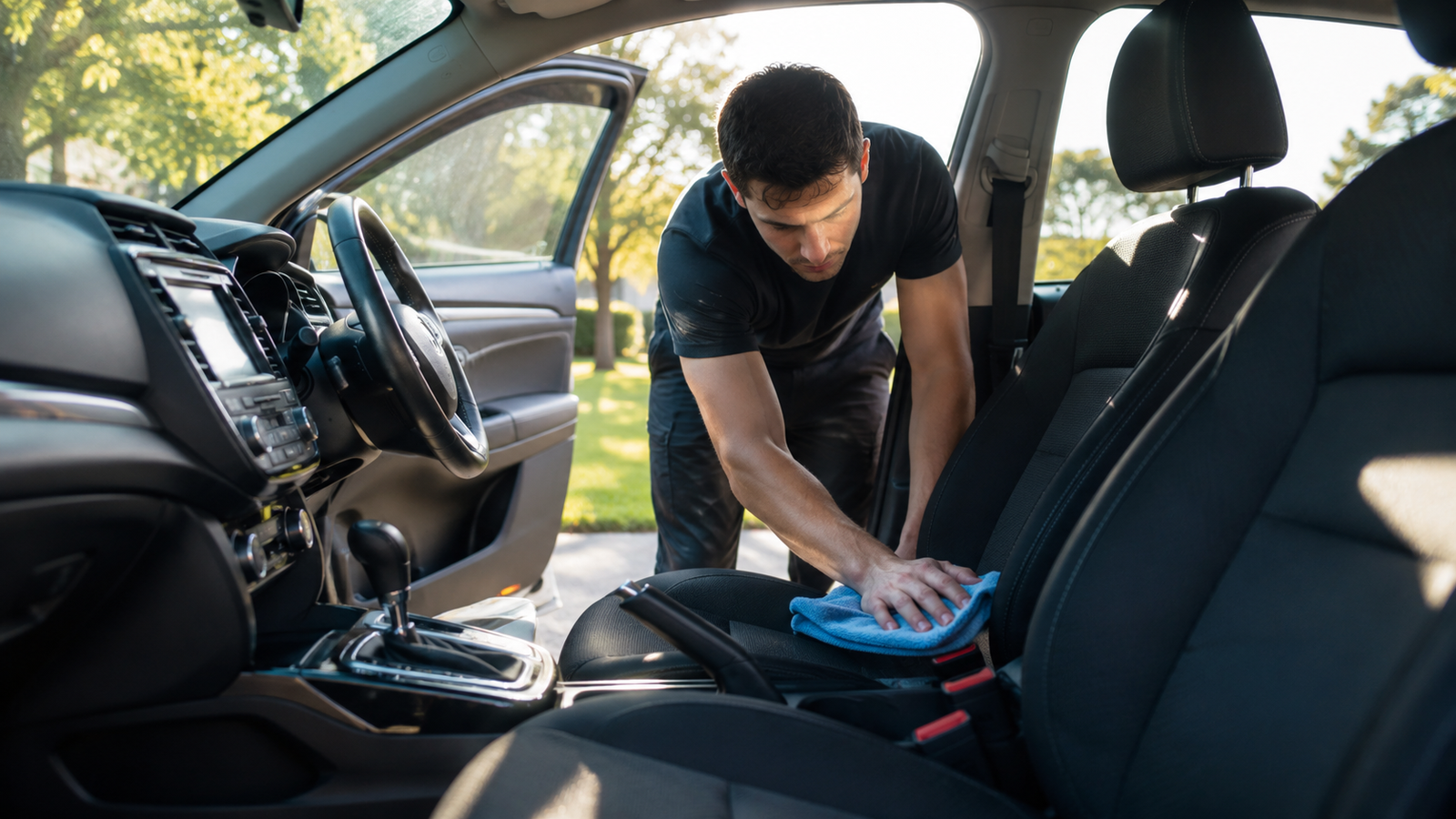
Cigarette smoke odor in a car is one of the most stubborn interior problems any vehicle owner can face. The smell penetrates fabric, foam, headliners, HVAC systems, and even hard plastic surfaces.
This guide walks you through proven methods, from deep cleaning to ozone treatment, that actually eliminate the odor at the molecular level, not just mask it.
What Makes Cigarette Smoke Smell So Hard to Remove from a Car Interior
Before reaching for an air freshener, it helps to understand why smoke odor clings so aggressively. Tobacco smoke contains thousands of chemical compounds, including nicotine, tar, formaldehyde, and acrolein. These volatile organic compounds (VOCs) don’t just float in the air, they bond to porous surfaces like seat foam, carpet fibers, and the headliner.
Third-hand smoke residue is the real culprit. Even after ventilation, the chemical residue left on surfaces continues to off-gas over time, which is why cheap sprays and hanging air fresheners never fully work. True odor elimination requires breaking down those chemical bonds through mechanical cleaning, enzymatic treatment, or oxidation.
Essential Supplies You Need Before Starting the Odor Removal Process
Getting the right products upfront saves time and prevents rework. Here’s what professional detailers typically use:
Cleaning agents:
- Enzymatic odor eliminator (such as Zout or enzyme-based upholstery cleaner)
- White vinegar diluted at a 1:1 ratio with water
- Baking soda (sodium bicarbonate)
- Activated charcoal packets
- Odor-neutralizing spray with OdorXit or similar VOC-targeting formula
Tools and equipment:
- Wet/dry vacuum with upholstery attachment
- Steam cleaner or handheld steamer
- Microfiber cloths
- Stiff-bristled upholstery brush
- Cabin air filter (replacement)
Optional but highly effective:
- Ozone generator (O3 machine)
- Thermal fogger
Having these ready before you start means you won’t need to stop mid-process, which affects the effectiveness of treatments that work best when applied in sequence.
Step-by-Step Deep Cleaning Method to Remove Smoke Odor from Car Seats and Carpet
Step-by-Step Deep Cleaning Method to Remove Smoke Odor from Car Seats, Carpet, and Interior Surfaces.
Step 1 – Remove And Vacuum Everything
Take out floor mats and seat covers. Vacuum every surface thoroughly, seats, carpet, under seats, door pockets, and dashboard crevices. Use the crevice tool in the seams of seats where smoke residue accumulates heavily.
Step 2 – Treat Fabric Surfaces With An Enzymatic Cleaner
Apply an enzyme-based upholstery cleaner to seats and carpet. Let it dwell for 10-15 minutes before agitating with a brush and extracting with a wet/dry vacuum. Enzymes break down the organic compounds in tobacco residue at the molecular level, this is what separates a real clean from a surface wipe.
Step 3 – Clean Hard Surfaces
Wipe down the dashboard, door panels, center console, and headliner with a vinegar-water solution. Don’t oversaturate the headliner, it’s glued to the roof, and excessive moisture causes it to sag. Use a lightly dampened cloth and work in sections.
Step 4 – Shampoo The Carpet And Floor Mats
Use a carpet shampoo with an odor-neutralizing additive. For severe smoke damage, a steam cleaner adds heat that helps break apart embedded residue. Allow at least 4-6 hours of drying time with windows open before proceeding.
Done correctly, this four-step deep cleaning process removes the bulk of embedded nicotine residue and tar deposits from your car’s interior surfaces, creating a clean foundation that makes every subsequent odor treatment significantly more effective.
How to Clean the Car’s HVAC System to Eliminate Smoke Smell from Vents
The ventilation system is the most overlooked source of recurring smoke odor. Smoke particles get drawn into the cabin air filter and coat the evaporator coil inside the HVAC housing every time you run the fan, the smell circulates again.
| HVAC Component | Why Does It Hold Smoke Smell | How to Treat It |
| Cabin air filter | Traps smoke particles in filter media | Replace completely, do not clean |
| Evaporator coil | Moisture makes it a sticky surface for VOCs | Use AC vent spray disinfectant |
| Ductwork | Residue coats the internal surfaces | Vent treatment spray with an extended nozzle |
| Blower fan | Draws air over coated components | Professional cleaning or disinfectant spray |
Process for HVAC treatment:
- Replace the cabin air filter first, this is non-negotiable and costs under $20 at most auto parts stores
- With the engine running and the AC on recirculation mode, spray an HVAC disinfectant into the intake vents near the base of the windshield
- Run the fan at maximum speed for 5-10 minutes to distribute the treatment through the system
- Switch to fresh air mode and run for another 5 minutes to flush out residue
Skipping the HVAC treatment is the number one reason smoke smell comes back within days of a deep clean.
Using Baking Soda and Activated Charcoal as Natural Odor Absorbers
After cleaning, the absorption phase helps pull out any remaining off-gassing VOCs. These natural odor absorbers don’t neutralize smoke odor on their own, but they work well as a second step after cleaning.
Baking soda method: Sprinkle generously over carpets and fabric seats. Let it sit overnight, or ideally for 24-48 hours. Vacuum thoroughly afterward. Baking soda works by neutralizing acidic odor molecules through a basic pH reaction. It’s safe on all fabric types and costs almost nothing.
Activated charcoal: Place open containers or packets of activated charcoal on the seats and floor with windows closed. Leave for 2-3 days. Charcoal’s porous structure adsorbs (not just absorbs) odor molecules, it physically traps them in its surface. It works slower than baking soda but is more effective for deep off-gassing situations.
Both methods work best when the car is sealed and not in use, parking in a warm garage overnight accelerates the absorption process.
While neither baking soda nor activated charcoal replaces deep mechanical cleaning, used consistently after treatment, they significantly reduce residual off-gassing and help maintain a genuinely fresh interior long after the initial odor removal process is complete.
Ozone Treatment | The Most Effective Method for Permanently Eliminating Car Smoke Smell
Ozone (O3) treatment is what professional detailers and used car dealers turn to when everything else fails. It’s the closest thing to a guaranteed solution for severe smoke odor.
How it works: An ozone generator converts oxygen (O2) into ozone (O3). Ozone is a powerful oxidizing agent that chemically reacts with and destroys odor-causing molecules rather than masking them. Because it’s a gas, it penetrates surfaces that sprays and cleaning tools can’t reach.
Safety warning: Ozone is harmful to breathe. Never run an ozone generator with people, pets, or plants inside the vehicle. The car must be completely unoccupied during treatment.
Protocol for ozone treatment:
- Place the generator on the passenger floorboard
- Run the car’s fan on recirculate to circulate ozone through the HVAC system
- Treat for 30-60 minutes depending on severity (severe smoke damage may need 2-3 sessions)
- Ventilate the vehicle for at least 1-2 hours after treatment before occupying it
- The initial ozone smell dissipates fully within a few hours and leaves no residue
Studies on VOC removal show ozone treatment reduces tobacco-related compounds by up to 90% in enclosed spaces. For cars with a heavy smoke history, this is the most effective single treatment available outside of full interior replacement.
White Vinegar Method and Steam Cleaning for Stubborn Nicotine Residue
White vinegar is acetic acid and it reacts chemically with nicotine alkaloids to neutralize them. It’s a cost-effective treatment that most people already have at home.
- Vinegar steam treatment: Fill a shallow bowl with undiluted white vinegar and leave it in the sealed car overnight. The vinegar vapor absorbs and neutralizes nicotine residue in the air and on nearby surfaces. The vinegar smell itself dissipates within 24 hours.
- Direct application: A 1:1 vinegar-water solution applied to upholstery with a microfiber cloth is particularly effective on leather seats and vinyl surfaces where nicotine leaves a visible yellowish residue.
- Steam cleaning: Adds another dimension. The heat from a steam cleaner (typically 120°C or higher) opens up fabric fibers, loosens embedded residue, and allows it to be extracted. Professional steam cleaning with an extraction wand on carpets and seats is one of the highest-impact steps for severe smoke damage.
Together, vinegar treatment and steam cleaning form a powerful two-step combination that tackles nicotine residue both chemically and physically making them the go-to approach before escalating to ozone for the most stubborn smoke-damaged interiors.
How Long Does It Take to Fully Remove a Smoke Smell from a Car?
Realistic expectations matter here. Most people underestimate the time needed for a thorough treatment.
| Severity Level | Estimated Treatment Time | Methods Required |
| Light smoke exposure (occasional smoking) | 1-2 days | Deep clean + baking soda absorption |
| Moderate (regular smoking over months) | 3-5 days | Full clean + HVAC treatment + charcoal |
| Heavy/chronic smoke damage | 1-2 weeks | Full protocol + ozone + possible headliner replacement |
| Car owned by heavy smoker for years | 2-4 weeks+ | Professional detail + ozone + partial reupholstery |
Multiple treatment passes are almost always more effective than one intensive session. Odor molecules continue to off-gas from deep within foam and fabric for days after initial cleaning, spacing treatments 48-72 hours apart lets you catch what the first pass missed.
When to Call a Professional Auto Detailer for Smoke Odor Removal
DIY methods handle most cases effectively, but there are situations where professional intervention gives better results and saves money long-term.
Signs you need a professional detailer:
- Yellow-brown nicotine staining on the headliner, which signals deep penetration
- Odor returns within 48 hours of treatment, indicating HVAC or foam saturation
- The car has been smoked in heavily for more than 2 years
- You notice sticky residue on windows and hard surfaces that resists cleaning
Professional auto detailers use commercial-grade ozone generators, industrial steam extractors, and thermal foggers that aren’t practical for home use. Average cost for a professional smoke odor removal detail runs between $150 and $400 depending on the vehicle size and severity.
For vehicles where the headliner has absorbed heavy residue, replacement may be more cost-effective than repeated treatments, headliner replacement typically costs $200-500 at an upholstery shop.
Knowing when to hand the job to a professional isn’t giving up. It’s often the most cost-effective decision when DIY treatments have already been exhausted, and the difference between a car that smells temporarily better and one that’s permanently restored.
Final Thoughts
Removing cigarette smoke smell from a car permanently is absolutely achievable, but it requires addressing every surface systematically, not just spraying something and hoping. The most common reason treatments fail is incomplete HVAC cleaning or skipping the enzymatic cleaning phase.
Start with a thorough deep clean, replace the cabin filter, treat the ventilation system, use baking soda or charcoal for absorption, and escalate to ozone treatment for severe cases. With the right approach, even heavily smoked-in vehicles can be restored to a genuinely fresh interior.
FAQs
Can You Permanently Remove Cigarette Smoke Smell From A Car?
Yes, with a systematic approach that includes deep mechanical cleaning, enzymatic treatment, HVAC decontamination, and odor oxidation (via ozone), smoke smell can be permanently eliminated rather than just masked.
How Long Does It Take For A Smoke Smell To Go Away In A Car On Its Own?
Without treatment, cigarette smoke smell does not go away on its own. VOC compounds continue to off-gas from surfaces for months or even years. Active treatment is necessary for genuine odor removal.
Does Ozone Treatment Really Work For Car Smoke Smell?
Yes, ozone treatment is considered the most effective method for severe smoke odor. Research shows O3 oxidation can reduce tobacco-related VOC concentrations by up to 90% in enclosed spaces.
Is It Worth Buying A Used Car That Smells Like Smoke?
It depends on severity and price. A professionally detailed and ozone-treated vehicle can be fully restored, but heavy smoke damage can require $300-500+ in professional treatment. Factor this into any negotiation.
Does Febreze Or Air Freshener Actually Remove Smoke Smell?
No, air fresheners and fabric sprays mask odor temporarily but do not eliminate the VOC residue causing the smell. They’re not a substitute for actual cleaning and odor neutralization.
Can The Cabin Air Filter Cause Smoke Smell To Persist?
Absolutely. A smoke-saturated cabin filter is one of the most common reasons odor returns quickly after cleaning. Always replace the cabin air filter as the first step in any smoke odor treatment.
Is White Vinegar Safe To Use On Leather Car Seats?
A diluted vinegar solution (1 part vinegar to 2 parts water) is generally safe on leather in small quantities, but avoids saturating the material. Always follow up with a leather conditioner to prevent drying.
How Much Does Professional Smoke Odor Removal Cost?
Professional smoke odor removal detailing typically costs between $150 and $400 for a full interior treatment including ozone. Severe cases requiring headliner replacement can add another $200-500.
Does Baking Soda Work On Car Smoke Smell?
Baking soda is an effective odor absorber for residual off-gassing after cleaning. It works by neutralizing acidic odor compounds, but it cannot replace mechanical cleaning of embedded residue.
What Is The Strongest Product To Remove Cigarette Smell From A Car?
An industrial-grade ozone generator is the strongest treatment available. For DIY cleaning products, enzyme-based upholstery cleaners (combined with steam extraction) deliver the most effective chemical breakdown of tobacco residue.