
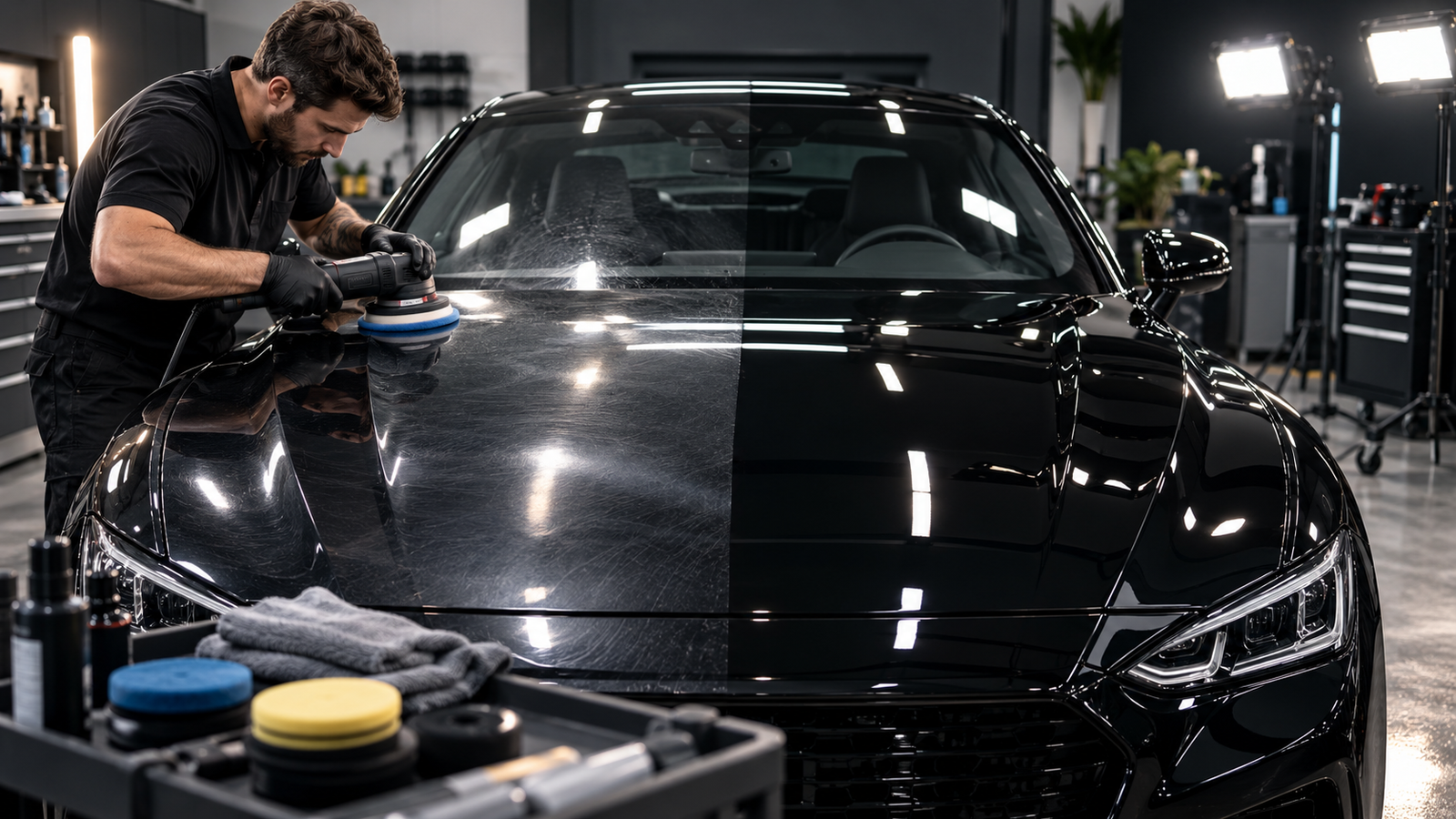
If your car’s paint looks dull, swirled, or scratched, you have probably come across the terms single-stage and multi-stage paint correction while researching how to fix it. These two approaches solve different problems and come with very different price tags and time commitments. Understanding the difference helps you avoid overpaying for a service you do not need, or worse, underpaying and being disappointed with the results.
This guide breaks down both methods so you can make an informed decision.
What Is Paint Correction and Why Does It Matter?
Paint correction is the process of removing imperfections from a vehicle’s clear coat using polishing compounds and machine polishers. Unlike a basic car wash or wax, correction actually levels the clear coat to eliminate swirl marks, light scratches, oxidation, water spots, and holograms left behind by improper washing or previous detailing work.
Most modern vehicles have a clear coat layer that is only a few microns thick, so this process requires skill and the right tools. A trained detailer uses a paint depth gauge before starting to measure how much clear coat is available to work with safely. Skipping this step is one of the most common reasons paint correction goes wrong.
Paint correction matters because it directly affects a car’s resale value, gloss, and overall appearance. A properly corrected finish reflects light evenly and looks noticeably deeper than paint covered in fine scratches. With that foundation in place, it is easier to understand where single-stage and multi-stage correction fit in.
What Is Single-Stage Paint Correction?
Single-stage paint correction uses one combination of pad and polish, applied in a single pass, to improve the paint’s appearance. It is designed for vehicles with mild imperfections rather than heavy damage.
This method typically removes:
- Light swirl marks from automatic car washes
- Minor water spots
- Slight dullness or fading in the clear coat
- Shallow surface scratches that do not catch a fingernail
Detailers often use an all-in-one (AIO) product or a light cutting compound paired with a foam polishing pad on a dual-action (DA) polisher. Because it involves less machine time and fewer product changes, single-stage correction is faster and more affordable than a full multi-stage job.
Single-stage correction is not meant to remove deep scratches, heavy oxidation, or long-neglected paint damage. Trying to force those results in one pass often leads to an uneven finish or unnecessary clear coat removal. That limitation is exactly why multi-stage correction exists.
What Is Multi-Stage Paint Correction?
Multi-stage paint correction, sometimes marketed as a two-step or three-step correction, uses multiple combinations of compounds, pads, and polishing steps to progressively refine the paint. Each stage removes a finer layer of imperfection than the last.
A typical three-stage process looks like this:
- Compounding stage: A heavier cutting compound on a wool or firm foam pad removes deep swirls, oxidation, and moderate scratches.
- Polishing stage: A medium polish on a softer pad refines the haze left behind by compounding and increases clarity.
- Finishing stage: A fine finishing polish on an ultra-soft pad maximizes gloss and removes any remaining micro-marring.
This layered approach is used on vehicles with significant surface damage, older paint that has never been corrected, or cars being prepared for a ceramic coating or paint protection film (PPF) installation. Because ceramic coatings and PPF lock in whatever condition the paint is in underneath them, most reputable installers recommend multi-stage correction beforehand rather than skipping straight to a coating.
Single-Stage vs. Multi-Stage Paint Correction: Key Differences
The table below summarizes how the two methods compare across the factors that matter most to vehicle owners.
| Factor | Single-Stage Correction | Multi-Stage Correction |
| Best for | Mild swirls, light dullness | Deep scratches, heavy oxidation, neglected paint |
| Number of passes | One | Two to three, sometimes more |
| Average time | 2 to 4 hours | 1 to 3 full days |
| Clear coat removal | Minimal | Moderate, closely monitored |
| Typical cost | $150 to $400 | $600 to $2,000+ |
| Gloss improvement | Noticeable | Maximum achievable gloss |
| Good pre-coating prep | For very new, well-maintained cars | Yes, standard for ceramic coating or PPF prep |
Pricing varies by region, vehicle size, and the detailer’s experience, but this range reflects typical rates across the United States detailing industry.
How to Tell Which Type of Paint Correction Your Vehicle Needs
The right choice depends on your paint’s current condition, not just your budget. A few practical checks can point you in the right direction before you book a service.
- Inspect under direct sunlight or an LED inspection light. Swirl marks and holograms show up clearly under strong, direct light, which is why professional detailers use dedicated inspection lamps rather than relying on garage lighting.
- Run your fingernail lightly over a scratch. If your nail catches, the scratch has likely gone through the clear coat, which means correction alone may not fully remove it.
- Consider the car’s history. A vehicle that has only been hand washed and garage kept usually needs less correction than one that has gone through years of automatic car washes.
- Think about your next step. If you plan to apply a ceramic coating or PPF, multi-stage correction is almost always the better investment since it maximizes what the protective layer preserves.
Reputable detailers, including those certified through organizations like the International Detailing Association (IDA), will typically perform a paint inspection and test spot before recommending a specific approach.
Cost Comparison: Single-Stage vs. Multi-Stage Correction
Cost is often the deciding factor for many car owners, so it helps to understand what drives the price difference. The table below breaks down the main factors that push pricing up or down.
| Cost Factor | Effect on Price | Why It Matters |
| Labor hours | Higher for multi-stage | Multiple compound and polish stages take more time to blend without damaging the clear coat |
| Vehicle size | Higher for larger vehicles | SUVs and trucks have more surface area than a compact sedan |
| Paint hardness | Varies by brand | Softer clear coats, common on some German and Japanese models, swirl easily but correct faster; harder coats resist marring but take longer to polish |
| Product quality | Higher with premium brands | Products from Meguiar’s, 3M, Rupes, or Menzerna cost more but give more predictable, consistent results |
| Paint condition | Higher for neglected paint | Heavier oxidation or deeper scratches require more compounding time |
Understanding these factors makes it easier to see why quotes can vary so widely between detailers, even for the same vehicle.
Time and Process: What to Expect During Each Service
Knowing what happens during your appointment helps set realistic expectations for both time and results.
For single-stage correction, expect the process to include a wash and decontamination, clay bar treatment if needed, one round of machine polishing, and a wipe-down before applying a protective wax or sealant. Most vehicles are ready within a single afternoon.
Multi-stage correction follows a more involved sequence:
- Wash and iron decontamination
- Clay bar or chemical decontamination
- Paint depth measurement across multiple panels
- Compounding stage with panel-by-panel inspection
- Polishing stage to refine clarity
- Finishing stage for maximum gloss
- Panel wipe-down and application of a sealant, wax, or ceramic coating
Because each stage is checked before moving to the next, multi-stage correction often takes place over one to three full days, especially for larger vehicles or paint with widespread damage.
Common Mistakes to Avoid When Choosing a Paint Correction Service
Choosing the wrong service, or the wrong provider, can lead to disappointing results or paint damage. Watch for these common pitfalls:
- Assuming cheaper always means the same result. A low-priced single-stage service will not fix damage that genuinely requires multi-stage correction.
- Skipping the paint depth check. Any detailer who does not measure clear coat thickness before aggressive polishing is taking an unnecessary risk with your vehicle.
- Correcting paint right before selling without protection. Correction without a wax, sealant, or ceramic coating afterward leaves the paint exposed and prone to marring again quickly.
- Choosing correction based on price alone rather than condition. The paint’s actual condition, not your budget, should guide which method is appropriate.
Avoiding these mistakes protects your investment, but correction is only half the equation. What you do with the paint afterward determines how long those results actually hold up.
How Paint Correction Fits Into a Complete Car Care Routine
Paint correction is not a one-time fix that lasts forever. It is one part of a broader car care routine, and pairing it with the right maintenance habits and protective products is what actually makes the results last.
Ongoing Maintenance Washing
Regular maintenance washing protects the work a detailer has just done. This means using a pH-neutral car wash soap, washing with the two-bucket method or a foam cannon to reduce contact with grit, and avoiding automatic tunnel washes with abrasive brushes that reintroduce swirl marks almost immediately after correction.
Ceramic Coatings
Ceramic coatings have grown in popularity because they add a hard, hydrophobic layer over corrected paint. This layer makes ongoing maintenance easier, improves water beading and dirt release, and helps protect the finish for one to five years depending on the specific product and application quality.
Paint Protection Film (PPF)
PPF offers a different kind of protection by adding a physical film layer rather than a chemical coating. It can self-heal from light scratches and swirl marks with heat exposure, which is why it is typically reserved for high-impact areas like the front bumper, hood, mirrors, and rocker panels.
Choosing the Right Combination
Combining the right level of paint correction with an appropriate protective product gives your vehicle the best chance of staying glossy and swirl-free for years to come. Many owners pair multi-stage correction with a ceramic coating for full-body protection, then add PPF on top of the coating in the areas most exposed to rock chips and road debris.
Many owners pair multi-stage correction with a ceramic coating for full-body protection, then add PPF on top of the coating in the areas most exposed to rock chips and road debris.
Final Thought
Single-stage and multi-stage paint correction solve different problems. Single-stage correction is a fast, budget-friendly way to refresh paint with only mild imperfections, while multi-stage correction is the right choice for vehicles with deeper scratches, heavy oxidation, or paint that has never been professionally treated. Before booking a service, have your paint inspected under proper lighting and ask your detailer to explain which stages your car actually needs. Matching the correction level to your paint’s real condition is the surest way to get a finish that looks great and lasts.
FAQs
How Long Does Paint Correction Last?
It lasts until new swirls form, typically six months to a few years, especially when followed by a wax, sealant, or ceramic coating.
Can Paint Correction Remove All Scratches?
No. It removes clear coat imperfections, but scratches reaching the base color or primer need touch-up paint or a repaint.
Is Multi-Stage Paint Correction Worth The Extra Cost?
Yes, for heavily swirled or oxidized paint, and especially before ceramic coating or PPF installation.
Does Paint Correction Damage The Clear Coat?
Done correctly with a paint depth gauge, it removes only a minimal, controlled amount. Skipping measurement is what causes damage.
How Do I Know If My Car Needs Single-Stage Or Multi-Stage Correction?
Check the paint under bright light. Light haze needs single-stage; deep scratches or heavy oxidation need multi-stage.
Should I Get A Paint Correction Before Selling My Car?
Yes. It improves gloss and curb appeal, which often supports a stronger asking price.
Can I Do Paint Correction Myself At Home?
Basic single-stage correction is doable with practice and a dual-action polisher. Multi-stage work is best left to professionals.
What Is The Difference Between Paint Correction And A Wax Or Ceramic Coating?
Correction fixes existing paint flaws. Wax and ceramic coatings protect the paint afterward and add gloss.
How Often Should Paint Correction Be Repeated?
Every few years for well-maintained cars, sooner for vehicles washed often at automatic car washes.
Does Paint Correction Work On All Paint Colors And Types?
Yes, though dark colors show swirl marks more visibly, so results tend to look more dramatic on them.